

Everything You Need to Know About Facelifts - Part 1 - Beauty and the Surgeon Episode 155
Thinking about a facelift is a big deal — and your consultation is where all the “What ifs?” start turning into a clear, personalized plan. We like to think of the facelift consultation and pre-op process as part detective work, part strategy session, and part honest heart-to-heart. Our goal: align your goals with surgical reality so you know exactly what you’re saying yes to.
Here’s what really happens when you come in for your pre op appointment.
Step 1: The Conversation (a.k.a. Aligning Goals and Reality)
We start with the most important thing in the room: you.
We’ll ask (again) what bothers you explicitly — jowls, neck, jawline, lower face, all of the above — and how long it’s been bothering you. This isn’t about the external; it’s about understanding what you see in the mirror and how it affects your confidence (the internal).
We’ll also ask what you want to see after surgery. Do you want to look “refreshed,” “less tired,” “more like yourself from 10 years ago”? The more specific you are, the better we can tailor our plan.
This is where we connect goals and reality. If you’re hoping a facelift will erase every fine line, fix sun damage, and change your nose, we’ll explain what it can do (and what other treatments might be better for the rest) — no false promises — just honest, realistic expectations.
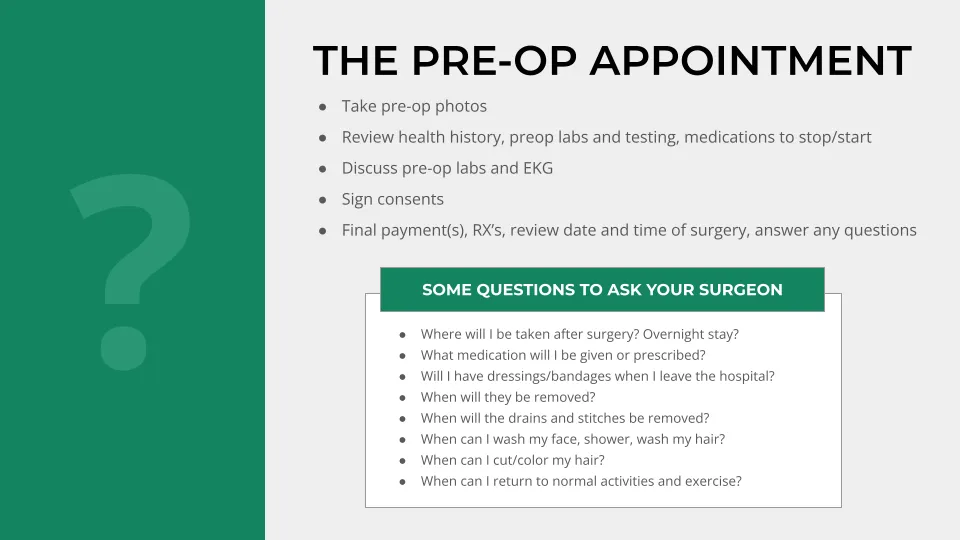
Step 2: Medical History — Not Just Paperwork
Next, we dive into your medical history, medications, and labs. It may not feel glamorous, but it’s absolutely crucial.
We’ll review:
-
Past surgeries
-
Medical conditions (like high blood pressure, heart disease, diabetes, thyroid issues, etc.)
-
Medications and supplements, including over-the-counter vitamins and herbal products
-
Any history of bleeding or clotting problems
-
Smoking, vaping, or nicotine use (yes, we really do need the truth here)
All of this helps us decide how to do your facelift safely. Sometimes that means adjusting medications, stopping certain supplements, or timing surgery to account for other health factors. Safety is not negotiable. And we have a low threshold for bringing in other specialists for guidance if any concerning medical conditions arise.
Why do I need preop labs before plastic surgery?
Step 3: Photos and Planning (Hello, Camera)
Then we’ll take standardized photographs of your face and neck from different angles. These aren’t “after” photos for social media; they’re medical tools.
We use these images to:
-
Document your baseline appearance
-
Map out the planned surgical changes and highlight symmetry issues
-
Plan incision placement and vector of lift
Think of it as our version of architectural drawings before a remodel. You wouldn’t want a contractor guessing — you don’t want your surgeon guessing either.

Step 4: Technique, Recovery, Risks, and Costs — The Nuts and Bolts
Once we review your anatomy, health, and goals, we’ll outline the recommended surgical plan.
We’ll discuss:
-
Which facelift technique we are recommending — full, short-incision, deep plane, SMAS-based, or a combination, and *why*
-
Whether we suggest additional procedures — like neck work, eyelid surgery, fat grafting, or skin resurfacing for the most transformative result
-
Expected recovery — bruising, swelling, time off work, and when you’ll feel “public-ready and front-facing.”
-
Risks and potential complications — not to scare you, but to give you an honest, informed picture
-
Costs and what’s included — so there are no financial surprises
This is your chance to ask about everything from scar placement to how long you’ll need a caretaker. We welcome detailed questions—they tell us you’re taking this seriously.
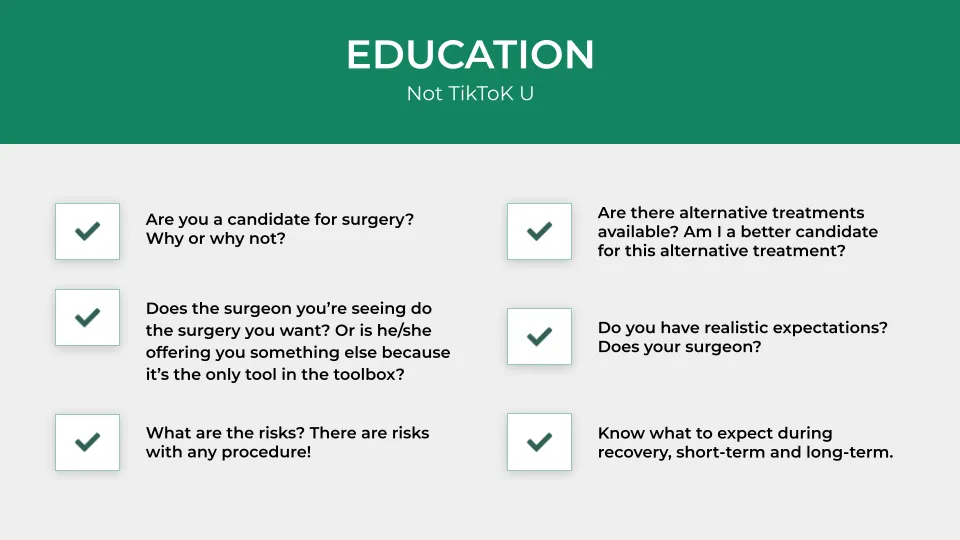
Step 5: Practical Pre-Op Details (Yes, Including Hair Color)
Once steps 1 - 4 are completed, we shift into full pre-op mode.
We’ll answer all the practical questions that pop up, like:
-
Where will you go immediately after surgery
-
Whether we use drains (and what that experience is like)
-
When you can shower and wash your hair
-
When you can return to work, social events, and eventually exercise
And yes, we absolutely talk about things like:
-
*“When can I color my hair?”*
-
*“Can I wear makeup to cover bruising?”*
-
*“What about my skincare routine?”*
These details might seem small, but they matter a lot when you’re planning real life around surgery.
To keep everything straight, we give you written checklists so nothing gets forgotten — when to stop certain medications, when to start pre-op skin care (if needed), what to bring on surgery day, and what to have ready at home. This is also the time that we make a supplementation around the surgery plan
The Big Picture: A Partnership, Not a Transaction
The pre-op process isn’t just about ticking boxes; it’s about building a partnership. Our job is to make sure everything runs smoothly. Your job is to bring your goals, your honesty, and your questions.
By the time you leave your facelift pre-operative appointment, you should feel informed, supported, and clear on what’s coming next — not rushed, pressured, or confused.
If you’re ready to explore whether a facelift is right for you, we’d love to sit down with you, go over your options, and create a plan that fits your face and your life.